

Horus… and the Royal Falcon: A Legend of Rule and Order

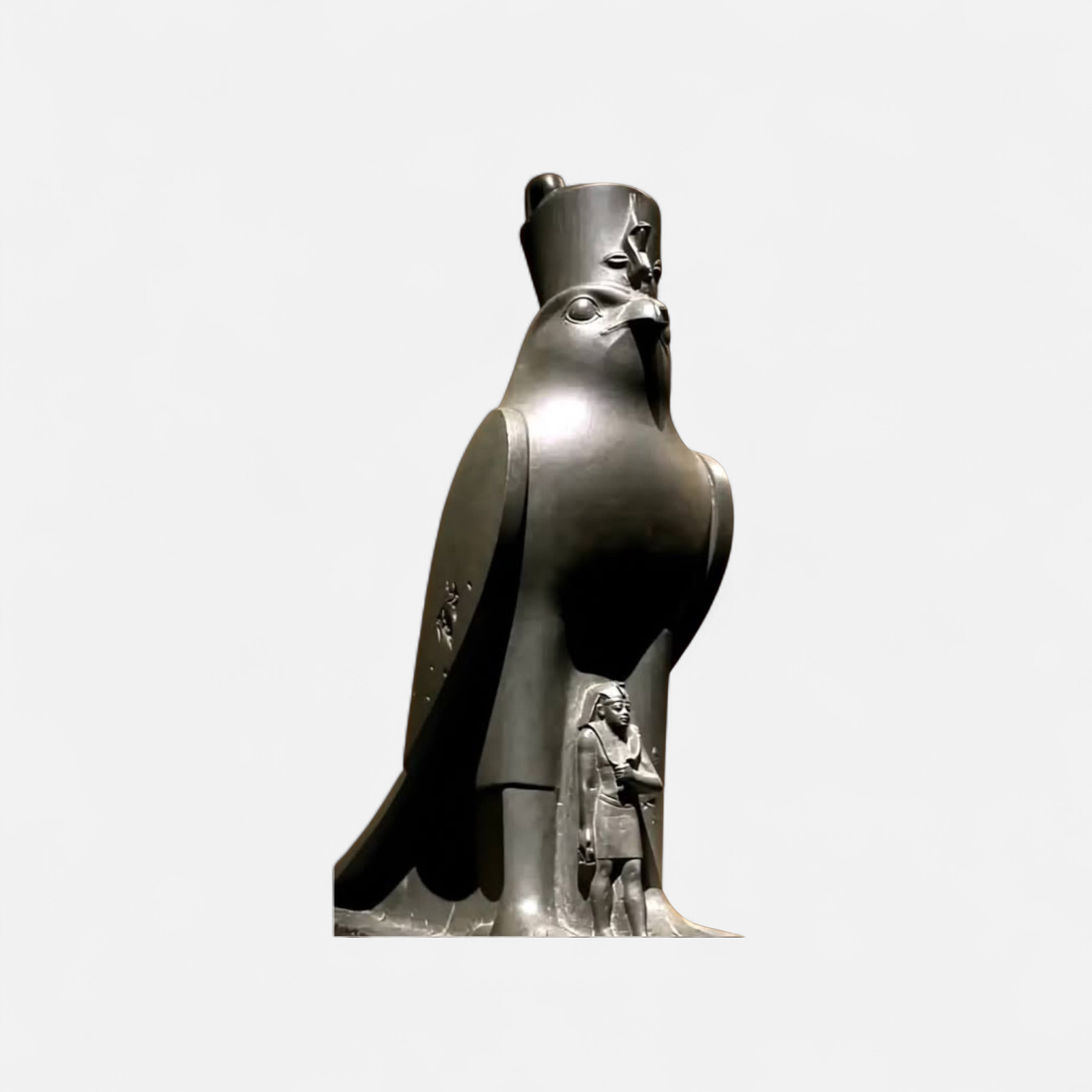
Horus is one of the oldest and most important deities in ancient Egyptian beliefs. He is the symbol that embodied the concepts of sacred kingship, the heavens, and the triumph of justice.
From the dawn of Egyptian history, his name was linked to the pharaoh himself, to the point that the king was considered “Horus on Earth,” representing supreme authority and preserving cosmic order.
In Egyptian mythology, Horus was not merely a fleeting symbol, but rather the embodiment of the eternal struggle between good and evil, order and chaos. His name is derived from the ancient Egyptian word “hor,” meaning high or exalted, referring to the falcon that soars in the heavens and watches over the earth with an unfailing eye.
Origin and Myth: The Epic of Isis and Osiris
The story of Horus revolves around one of the greatest myths of the ancient world. Horus was born an orphan after his father, Osiris, was murdered by his brother, Set, the god of chaos and violence, who usurped the throne by force. Isis, the symbol of loyalty, magic, and wisdom, protected her child, hiding and raising him in the marshes of the Delta, far from Set’s eyes, until he grew strong enough to reclaim his rights.
When Horus reached maturity, he waged a long series of fierce battles against his uncle Set, a struggle that was not only physical but also symbolic, reflecting the confrontation between order (Ma’at) and chaos.
In the end, Horus triumphed and was installed as ruler of Egypt, becoming the sacred archetype for every pharaoh who ruled the land.
The Eye of Horus (Wadjet): During his struggle with Set, Horus lost his left eye, but Thoth, the god of wisdom and knowledge, was able to restore it completely. From this, the symbol of the Eye of Horus was born, one of the most famous and sacred symbols in ancient Egyptian civilization, representing:
Healing and perfection.
Protection from evil and envy. Science and mathematics, where its parts were used to represent fractions.
This is why the Eye of Horus was widely depicted on coffins, walls, and jewelry, as a symbol of protection in this life and the afterlife.
Forms and Manifestations of Horus:
Horus did not appear in a single form, but rather in multiple manifestations reflecting different aspects of beliefs and nature. Among the most prominent are:
Horus the Elder (Hor-Wer): The eternal sky deity, whose eyes represent the sun and moon.
Harukart (Child Horus): A symbol of innocence and new beginnings.
Ra-Horakhty: A symbolic union between Horus and Ra, embodying the power of the sun on the horizon.
Horus and Political and Religious Symbolism:
From the First Dynasty of Egypt, the relationship between Horus and the king was one of complete fusion. Every pharaoh adopted the Horus name as his first royal title, expressing his status as the earthly incarnation of Horus.
It was believed that upon death, the king transformed into Osiris, lord of the underworld, while the new king became Horus, thus perpetuating the cycle of divine rule.
His Worship and His Eternal Temple:
The city of Edfu in Upper Egypt was the main center for the worship of Horus, and the Temple of Edfu is considered one of the most complete and beautiful Egyptian temples surviving to this day.
Its gateway is adorned with colossal statues of the falcon Horus, while the reliefs on its walls recount his struggle and victory over the forces of chaos in an epic of timeless stone.
Horus remains a symbol of hope born from suffering and of courage in the face of injustice. He was not merely a falcon soaring in the sky, but rather the symbolic pillar of stability for the ancient Egyptian state for thousands of years, and an enduring embodiment of the triumph of order and justice.
◾️Article by Eman Sayed..